Is a splash pad a cheap summer treat, or a bill that keeps growing after the install? In Las Vegas, the cost splits into three parts: the build, the water and the upkeep. Each part moves with the design choices you make, so no single number fits every pad.
Families and property owners look at water play in summer because the heat makes an outdoor spray useful for kids. A recirculating system is a design where water collects in a holding tank, passes through a filter and disinfectant, and is pumped back to the spray nozzles instead of draining after one use. This guide covers build cost, water use, upkeep, public admission prices and operating hours. The Bay Area parks cited here are reference points only, not Las Vegas pricing.
The first question is what drives the build price, and the answer starts with the water features you choose.
Key Takeaways
- Build, water and upkeep make up the full cost.
- Design and site set each of those numbers.
- A Las Vegas install price needs a line-item quote.
- A recirculating system reuses the same water.
- Public pads range from free to paid drop-in.
What the Feature Does and Who It Suits
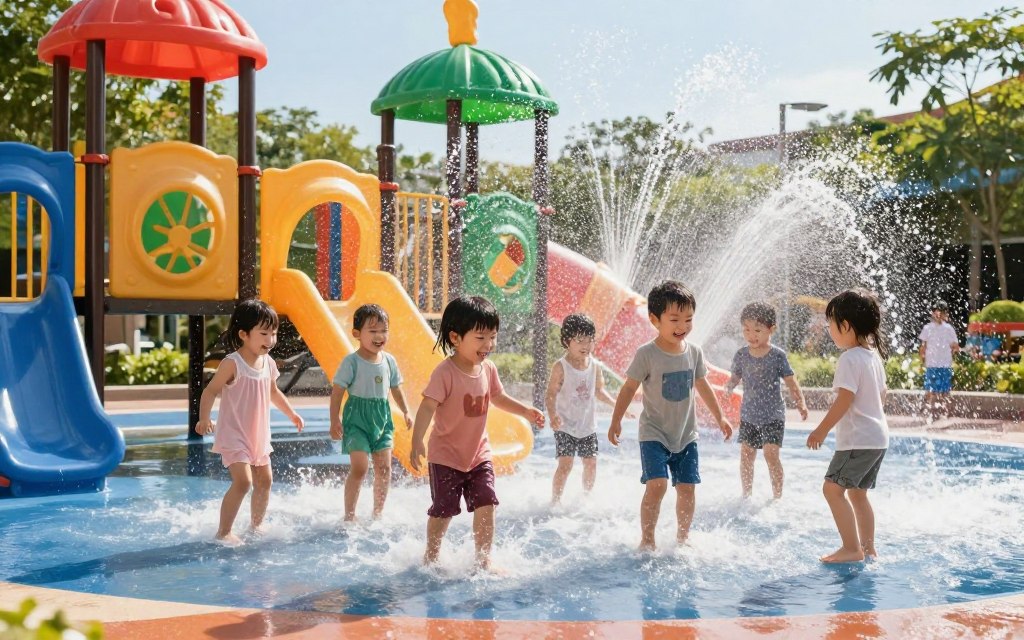
A splash pad is a shallow, ground-level play area with sprays, jets and buckets. Children run through the water, and nothing is deep enough to swim in. Most pads have no standing pool, so the water either drains or cycles through a loop, depending on the design.
Pads are most often placed in playgrounds. Toddlers who are not yet swim-ready are the group they suit best. Older children use them too, so the water play draws kids of many ages to the same spot.
The play structure beside the pad is the other half of the appeal. A climbing frame or slide keeps children busy between sprays, and parents can sit close by while they play.
A common mistake is buying a pad for a site where toddlers and teens share one open area with no separate zones. Tall sprays and big jets can knock over a small child, so the layout should split the area by age.
What age is appropriate for a splash pad? Splash pads suit toddlers and preschoolers most. Older children can use the same pad when it has separate water features built for bigger kids. That split is the first design choice to settle, and it leads straight to what raises the build price.
What Drives the Build Price
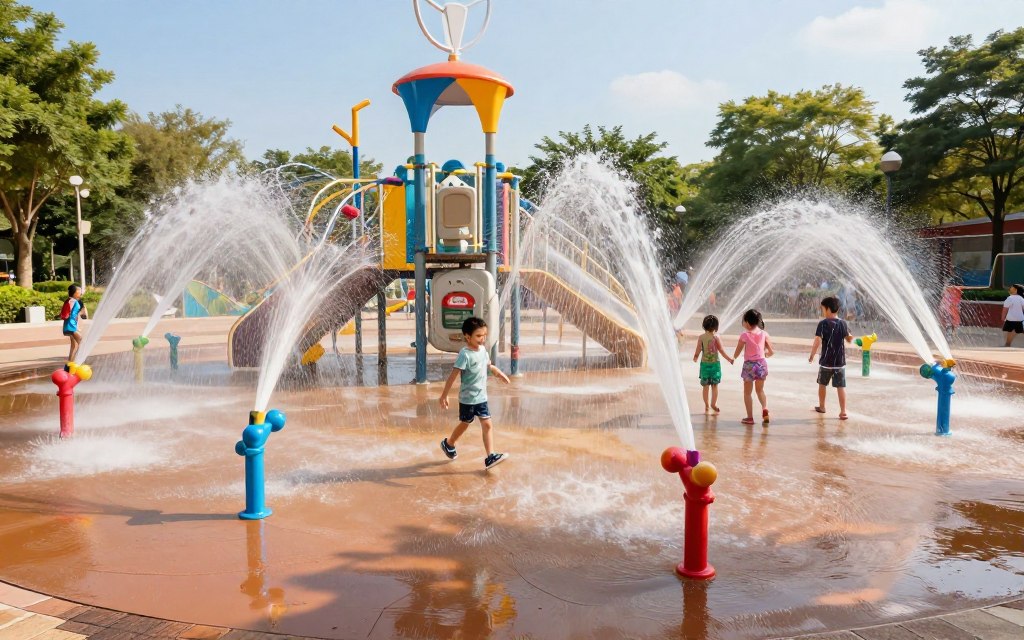
The spray heads are the smallest part of most splash pad budgets. The bigger costs sit in the concrete, the plumbing and the equipment room that keep the water moving.
These five cost drivers are general knowledge about how pads are built. They show what moves the price up or down, but they are not a price list.
- Water features and nozzles: umbrella sprayers, dumping buckets, geysers and mushroom fountains each need their own nozzles and plumbing.
- Spray area size: a larger deck needs more concrete, more piping and more drain capacity.
- Surfacing: padded turf, poured surface and stone each cost a different amount to install and to keep.
- Pump room, filter and drainage: the equipment room and drain often cost more than the spray heads.
- Controls and timers: push-button, timed or always-on controls each add wiring and a control panel.
A common mistake is budgeting for the spray heads and forgetting the pump room, drain and filter. Those parts make the pad work, and they rarely appear in a brochure. For a wider look at drainage, surfacing and water supply, read this guide to planning a backyard water play area before you ask for quotes.
That leaves the question most readers ask first: what a build actually costs in Las Vegas.
How Much Do Splash Pads Cost to Build in Las Vegas
No Las Vegas install price for a splash pad is published here, because the build cost depends on the site, the design and the water system. A figure from another city would not fit a Las Vegas lot, so none is given.
The only build-related figures in this guide are admission fees at Bay Area public pads. Those fees reflect how each city runs its parks, not what a private pad costs to install.
To get a real figure, ask for a line-item quote. It should cover the spray area, surfacing, pump and filter, drainage, electrical and controls. Each line shows which part drives the total, so you can compare two bids fairly.
Ask whether the quote includes permits, and whether the water system is recirculating or single-pass. A single-pass pad uses fresh water every time and drains it, which changes the water bill for the life of the pad.
Summer highs above 100 F are common in Las Vegas, so put shade and surface temperature into the quote. A hot deck can burn bare feet, and shade structures add a separate line item.
How expensive is a splash pad to build? The build price depends on design and site, so expect the install to be the largest first payment. Get a line-item quote before you set a budget. If you search for splash pads near Las Vegas, NV, look for installers whose proposals list the water system and surfacing separately. A consumer guide to backyard splash pad models is also useful for comparing spray features, size and drainage before you request quotes.
Water use is the next cost, and it depends on whether the same water loops back to the spray.
Water Use and the Recirculating System
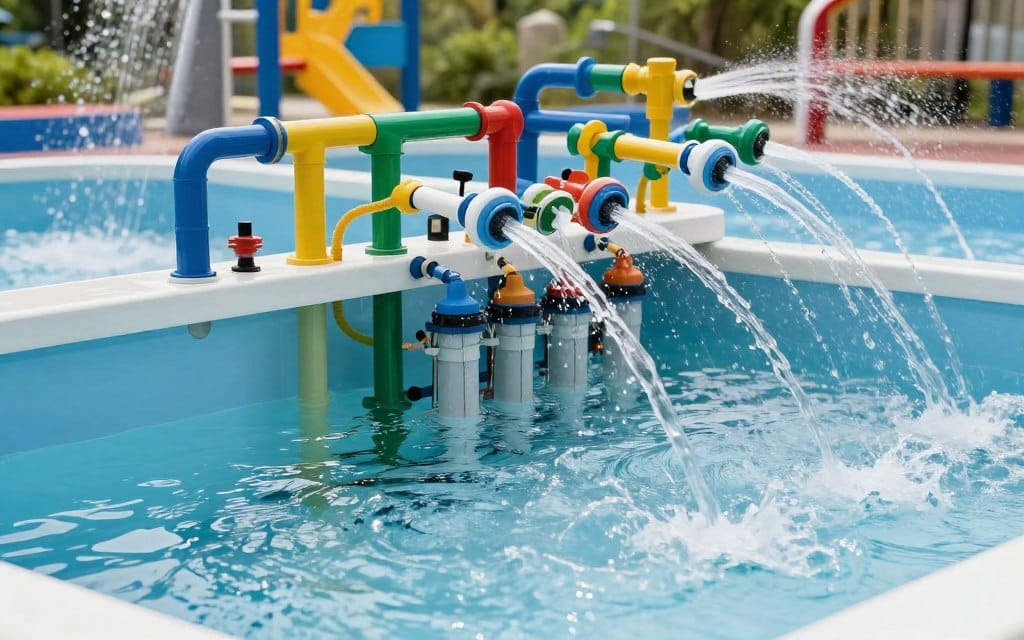
A splash pad reuses water when it has a holding tank, a filter and a pump that send the same water back to the spray. Without that loop, the pad uses fresh water for as long as the feature runs.
How a Recirculating System Reuses Water
A recirculating system reuses the same water through the day and makes up only what it loses. A single-pass pad sends fresh water through the spray and drains it, so the water use runs for as long as the feature does.
The splash pad maker Waterplay Solutions Corp. advises weighing the site, drainage and water supply before choosing a design. Its planning guide for splash pads also warns that an oversized pad raises concrete and piping costs.
In a hot climate like Las Vegas, evaporation is the main source of make-up water. A pad that runs all day loses more water to the air than one that runs on a timer, so the design and its controls matter.
Where Water Use Shows Up on the Bill
Water use on the bill comes mostly from make-up water, which replaces water lost to evaporation, splash-out and backwash. Those losses are the reason a recirculating pad still needs a water connection.
No gallon or dollar figure for water use is given here. Ask the designer for the expected daily make-up water, and check with the local water utility for any rules on decorative or play water features.
Once you know the water loop, the next question is what a visit costs a family at a public pad.
Admission Prices at Public Pads
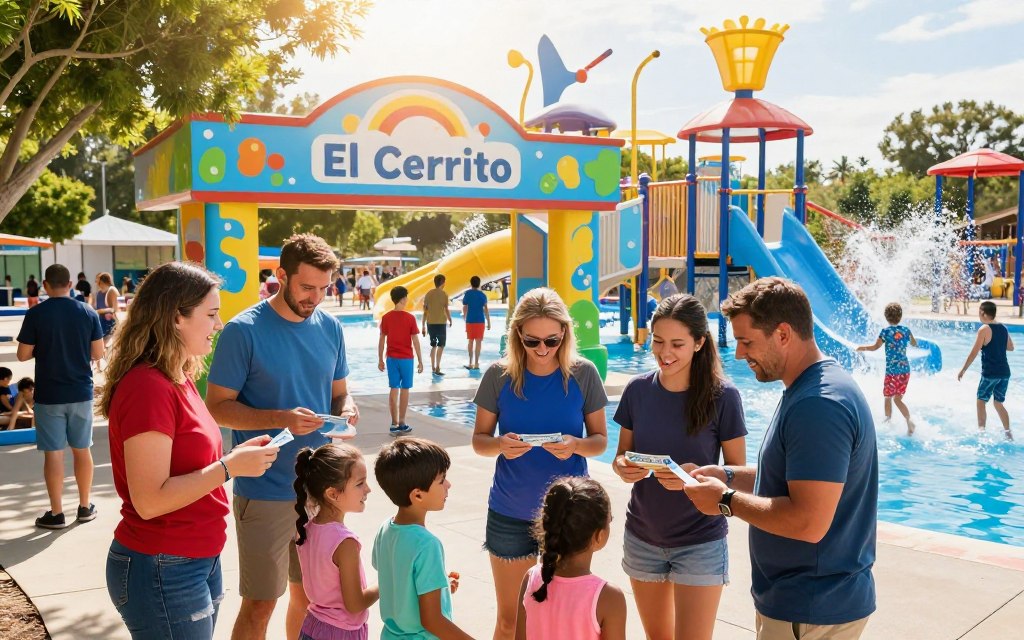
Many public splash pads are free, while some charge a drop-in fee for each visit. The paid options below show what a family pays when a city charges admission.
Most Bay Area splash pads in this guide are free. The five paid options in the table show how the price changes from one city to another.
| Park | City | Price | What the Price Covers | Note |
|---|---|---|---|---|
| Larkey Sprayground | Walnut Creek | $2-$7 | Entry to the sprayground | Price varies within the range |
| El Cerrito Splash Park | El Cerrito | $5 drop-in | One visit to the splash area | No lifeguard and no pool access |
| Rinconada Pool | Palo Alto | $15 for a family of four | Pool and family entry | Restrooms and changing rooms |
| Allan Witt Park Aquatics | Fairfield | $5 kids, $6 adults | Aquatics admission | Priced per person |
| Morton Warm Springs | Glen Ellen | $15-$25 per person | Sliding-scale admission | Children under 3 enter free |
No Las Vegas public pad price is given here, so treat these Bay Area numbers as reference points only. A Las Vegas price depends on the city’s own posted rate, which you should check before a visit.
A family with several young children may find a pass cheaper than repeated drop-ins. Hamilton Community Pool open swim passes are under $10, which can beat paying a drop-in fee on each trip.
A cheap visit only helps if the pad is open, so the seasonal window comes next.
Seasonal Hours and Opening Dates
Most public pads run from late spring through Labor Day, and some run into October. The table shows the operating window for five Bay Area pads so you can plan the season.
| Park | Open Window | Days | Daily Hours | Season End |
|---|---|---|---|---|
| Cannery Park (Hayward) | June 10 to August 3, then August 4 to September 2 | Wednesday to Sunday and holidays, then weekends and holidays only | 11am-5pm | September 2 |
| Castro Valley Park Splash Pad | June through August | Same pattern as Cannery Park | Not confirmed | August |
| Meadow Homes Spray Park (Concord) | Summer | Daily | 12pm-6pm | September 29 |
| Blue Goose Park (Brentwood) | Daily until October 31 | Daily | 10am-7pm | October 31 |
| Hellyer Park (San Jose) | Turns on when air reaches 70 F | Not confirmed | Not confirmed | Not confirmed |
The seasons end on different dates in each city. An October visit to Cannery Park would find it closed, while Blue Goose Park is still open until October 31.
Other pads follow their own schedules. Allan Witt Park Aquatics is open Friday to Sunday from 12pm to 4pm until Labor Day, and El Cerrito Splash Park is open daily from 11am to 7pm. The hours above are the cities’ posted hours, so confirm them before you travel because posted schedules can change.
A pad that is open on the calendar still needs regular care to stay safe, and that is where upkeep comes in.
Upkeep Tasks That Keep the Surface Safe
A jet that sprays sideways is often a nozzle that has shifted. Staff can miss it because the feature still runs, and the play area keeps working while the spray goes off target.
The five upkeep tasks below are general knowledge about splash pad care. Each one protects the water loop or the surface a child walks on.
- Nozzle and jet checks: look for clogs and aim daily or weekly.
- Filter cleaning on schedule: follow the interval the manufacturer sets for the pad.
- Disinfectant and pH testing: test and adjust on a set schedule, not only when the water looks cloudy.
- Drain and holding tank debris removal: clear leaves and grit before they reach the pump.
- Surface inspection for cracks and trip edges: check for loose pads and raised edges.
A clogged nozzle is the easiest fault to miss. The weak spray looks like normal play until a child is hit by a sideways jet or the flow drops at the centerpiece.
Surface checks matter as much as the water. A cracked deck or a raised edge trips children, and a loose tile shifts under wet feet.
Clean surfaces and sound nozzles still need clean water behind them, and that is where treatment comes in.
Keeping Splash Water Clean and Safe to Touch
Splash water is only as clean as its treatment. The filter and disinfectant set the standard, and a neglected filter lowers it quickly.
The CDC guidance on staying healthy at splash pads notes that these pads may not be regulated or required to disinfect water. It also says that inadequate disinfection can let germs spread among children.
Chlorination and Filtration Basics
The filter catches debris, and the disinfectant kills germs in the loop. Stanford’s Red Hoop Fountain and Sunken Pool are chlorinated regularly, which is one example of a scheduled treatment that keeps the water on track.
Water can still carry germs when children bring them in, even with treatment running. A pad cannot filter out what a sick child leaves in the water, so the treatment works best alongside the rules that keep sick children out.
Cleaning and Draining Schedules
Ask the operator for the treatment and testing schedule before you visit. Ask also how often the water is drained or the holding tank is cleaned, since those intervals decide how fast the water turns poor.
No test results are published here, so this guide does not call any pad clean or dirty.
How dirty is splash pad water? It is only as clean as its disinfectant and filter keep it, and it can carry germs from children. How nasty are splash pads? A well-run pad is not a dirty pool, but a poorly run one with a neglected filter is a source of germs.
Those germs matter most for the illnesses kids can catch from swallowed water.
Health Benefits and Illness Risks for Kids
Splash pads are a healthy way to cool off when the basic rules are followed. Children get active play in the heat without a deep swim pool, and they can run, jump and spray for as long as they like.
The main illness risk is a gastrointestinal illness from swallowed water. Cryptosporidium is a parasite that can survive ordinary chlorine levels for a time, and it is a common cause of illness linked to splash pads.
What illnesses can splash pads cause? The illnesses most linked to them are gastrointestinal, such as those caused by cryptosporidium. Children are most likely to catch them by swallowing water while playing.
Practical steps lower that risk. Keep children with diarrhea out of the water, have every child shower before entering, and take bathroom and diaper breaks away from the pad. Teach children to avoid swallowing water.
Are splash pads healthy? They offer active play and cooling, and they are healthy when children stay out if sick and swallow little water. Keeping a sick child out is one layer of protection, and watching the water is the next.
Supervision, Restrooms and Shade at Public Parks
A splash pad with no lifeguard needs a supervising adult at all times. Children can get into trouble in seconds, and no staff member may be watching the water.
The table shows what five public pads offer for supervision, restrooms and shade. Not confirmed means the park’s listing does not state it, so ask the park before you go.
| Park | Lifeguard | Restrooms or Changing | Shade |
|---|---|---|---|
| El Cerrito Splash Park | No lifeguard on duty | Not confirmed | Not confirmed |
| Rinconada Pool | Not confirmed | Restrooms and changing rooms | Shaded areas available |
| Antioch Water Park | Lifeguards on duty all day | Not confirmed | Not confirmed |
| Meadow Homes Spray Park | Not confirmed | Not confirmed | Shaded picnic spots |
| Seven Seas Park | Not confirmed | Not confirmed | Plentiful shade, tricky parking |
Meadow Homes Spray Park is crowded on hot days, so the shaded picnic spots fill early. Seven Seas Park has plenty of shade, but its parking is tricky to reach.
Larkey Sprayground sets a maximum capacity of 60 users, a limit set by the county. Once that number is reached, visitors join a waiting list. Before you visit the Castro Valley Park Splash Pad, confirm its supervision rules with the city, because this guide lists no lifeguard for that pad.
Run through these checks before every visit:
- Confirm lifeguard coverage: ask whether a lifeguard is on duty during your hours.
- Check the capacity limit: busy pads may close the gate at a set number of users.
- Plan shade and restroom access: know where the shade and restrooms are before you unpack.
- Arrive early on hot days: the first hour is the least crowded and the coolest.
- Bring a change of clothes and snacks: wet children get cold in shade, and snacks keep them off the fountain edge.
A splash pad without a lifeguard is not a substitute for a supervised pool. Supervision and shade matter most while the pad runs, and most public pads run only when someone switches them on.
How Water Play Gets Switched On
Most public splash pads use a push-button or timed control rather than running all day. The control decides when the water flows, how long a visit lasts and how much water the pad uses.
The table lists how five public water features are activated and when they run.
| Park | Activation | When It Runs | Practical Note |
|---|---|---|---|
| Castro Valley Park Splash Pad | Red button | Not confirmed | Press to start the features |
| Cannery Park | Big red button | 11am-5pm on operating days | Press once to start the water |
| Maddux Park | Push-button frog feature | All day once started | Frogs run on push-button start |
| Magical Bridge Playground | Push-button | Daily from 10am | Water areas start on a press |
| Stafford Park | Timed | May to October, 11am-7pm | Breaks at 12-1pm and 3-4pm |
A push-button feature can stop after a set time, so a child who walks away may leave it off for the rest of the visit. A timed feature can turn off during a park event, even when you expected the water to run.
El Cerrito Splash Park runs a spray program with dumping buckets, misting tunnels and jets. Its program follows a set run, so a visit timed to the program hour gets the most water play.
Controls also shape running cost. A timed or push-button pad uses water only while it runs, while an always-on feature uses water all day. A splash pad is a short, low-cost visit, which sets up the difference between a pad and a full water park.
When a Water Park Costs More Than a Free Pad
A water park costs more because it adds slides, pools and rentals that a splash pad does not have. A splash pad is usually a short, low-cost visit, while a water park is a full day out.
The cost rises with each add-on. These five features are the most common reasons a water park charges more than a splash pad.
- Slides: tall water slides turn a visit into a ticketed attraction.
- Lazy rivers: a looping channel carries swimmers around the park on a gentle current.
- Wave pools: a large pool with artificial waves for swimmers of all ages.
- Cabanas: private poolside spaces that visitors rent for a day.
- Tide pools: shallow pools with water play, such as those at South Bay Shores at Great America.
Discounts and Pass Holder Entry
Antioch Water Park gives residents an admission discount, so check whether your city offers one before you pay full price. Gilroy Gardens’ Water Oasis is included with regular park admission, so a park ticket may cover the water play without a separate fee.
This guide lists no water park admission prices, so check the current price on the park’s own site before you plan the budget.
Cabanas and Other Add-Ons
Six Flags Hurricane Harbor rents private poolside cabanas and picnic groves, which are the main upgrades that raise a visit’s cost. The Wave in Dublin opened in May 2023 and includes a splash pad with water jets, slides and a tilting bucket.
A water park is not the right choice for a toddler who only wants to splash for an hour. A free or low-cost pad fits that need better, and the regional examples below show how Bay Area cities build pads without a full water park.
Building a Yearly Budget for Ownership
A yearly budget for a splash pad has four lines, not one. Each line covers a different cost, and a single total hides which one is growing.
The first line is the build cost, spread over the pad’s expected life. The second line is the make-up water bill. The third line covers upkeep tasks and parts, such as nozzles, filter media and disinfectant. The fourth line is seasonal staffing or supervision.
No figures are given here, so fill each line from the line-item quote and the water bill. The quote shows the build, and the utility bill shows what the water actually costs.
A pad that runs all day in a Las Vegas summer may cost much more to run than one with a timer, so set the schedule before the budget. Features on push buttons or timers use water only when they run, which lowers the make-up line.
With the budget set, the last step is to get quotes that show each line clearly.
Regional Examples From Bay Area Parks
Splash pads in California range from a mist fountain in a plaza to a full play area. The examples below are Bay Area reference points, not Las Vegas pricing, and no build price is given for any of them.
East Bay and North Bay Examples
City Center Fountain in Alexander Square in San Ramon releases a soft mist for about 10 minutes every hour. Central Park in San Ramon has umbrella sprayers and a faux creek, which give younger children a spray zone with room to wander.
A mist-only fountain at a plaza is not a play pad. A family with toddlers may find it too open, because there is no structure to climb and little to hold a child’s attention for long.
Peninsula and South Bay Examples
Mission Playground in San Francisco was renovated with a clubhouse, a pool with lockers, pathways and shaded areas. The layout gives families a place to change, rest and stay out of the sun between visits to the water.
Stanford’s Red Hoop Fountain and Sunken Pool are chlorinated regularly, so the water stays on a set treatment schedule. Rinconada Pool in Palo Alto has mushroom fountains and stationary pedal bikes that shoot water when a child pedals.
At 24th and York Mini Park in San Francisco, a serpent play structure sprouts water from its tail. In downtown San Jose, Plaza de Cesar Chavez has water shooting from the ground, which makes the plaza itself the play area.
Each of these layouts answers a different question about who uses the water and how, which is the choice you face next.
Choosing a Design Between Spray Features and Play Structures
Seven Seas Park in Sunnyvale has a huge splash pad with a climbing rope, a metal structure and a pirate ship. Designs like this one put a play structure at the center, while others focus on sprays alone.
Choose the design by asking who will use the pad most. These five design choices each match a group of users.
- Umbrella sprayers and mist for toddlers: low, gentle spray that small children can reach safely.
- Dumping buckets for mixed ages: a timed bucket that drops water on a crowd of different sizes.
- Geysers as a centerpiece: a single strong spray that anchors the pad, as at Ortega Park in Sunnyvale, where huge flowers spray from bubbling geysers.
- A play structure for older children: a slide or climbing frame for kids who want more than water.
- A mist fountain for a plaza: a soft spray for an open public space with mixed use.
A design that puts big children’s jets next to toddler sprayers without zones leaves toddlers at risk. Separate the zones with a fence line, a change in height or a different spray type.
A South Bay play structure and an East Bay sprayer layout solve different problems. Hamilton Community Pool in Novato pairs a play structure with a slide and water sprayers, while Prince Gateway Park in Santa Rosa offers a free cooling spray.
With a design in mind, the last step is turning it into a quote you can compare.
Conclusion
The cost of a splash pad is set by its design and its water system. The build price depends on the site, the surfacing and the controls, and no Las Vegas install figure is given here, so a line-item quote is the only reliable number to plan with.
The running cost depends on the water system and the schedule. A recirculating loop and a timer keep the water bill lower than a pad that drains after every use and runs all day.
Taylormade Landscapes® is a residential and commercial landscaping firm that can walk through site, drainage and surfacing questions before you request a quote. Request two or three line-item quotes that break out the water system, surfacing and controls, and ask each installer for the expected make-up water.