Can one cold night crack the pipes of a backyard splash pad in Las Vegas? Yes, a night at or below 28°F can split a water line that still holds water. Learning how to winterize a backyard splash pad takes one short session and protects the pipes and pumps.
The short answer is to drain the lines, shut off power and water, cap the nozzles, and keep the holding tank at least half full. Purge means pushing the water left in a line out with compressed air so it cannot freeze. Those steps run in reverse when spring arrives.
For busy homeowners, winterizing is a short, one-time seasonal task. It is low-maintenance care that keeps the pump and pipes ready for the next season. Most owners finish it in one session, even with a Las Vegas backyard setup.
Las Vegas winters are mild, so the risk is not constant freezing. The real danger is the single cold night that catches a line full of water. A pre-winter shutdown takes less time than one emergency repair in spring, so a single planned session covers the season. If you are still pricing a new system, see what a splash pad costs in Las Vegas.
Key Takeaways
- Purge the lines before any freezing weather arrives.
- Shut off power and water before you touch the pump or lines.
- Cap every nozzle with winter caps after it is cleaned.
- Keep the holding tank at least half full through winter.
- Set the shutdown date by temperature, not only by the calendar.
- Run the filter pump for a full day before the feature pump in spring.
When to Winterize Your Splash Pad in Las Vegas
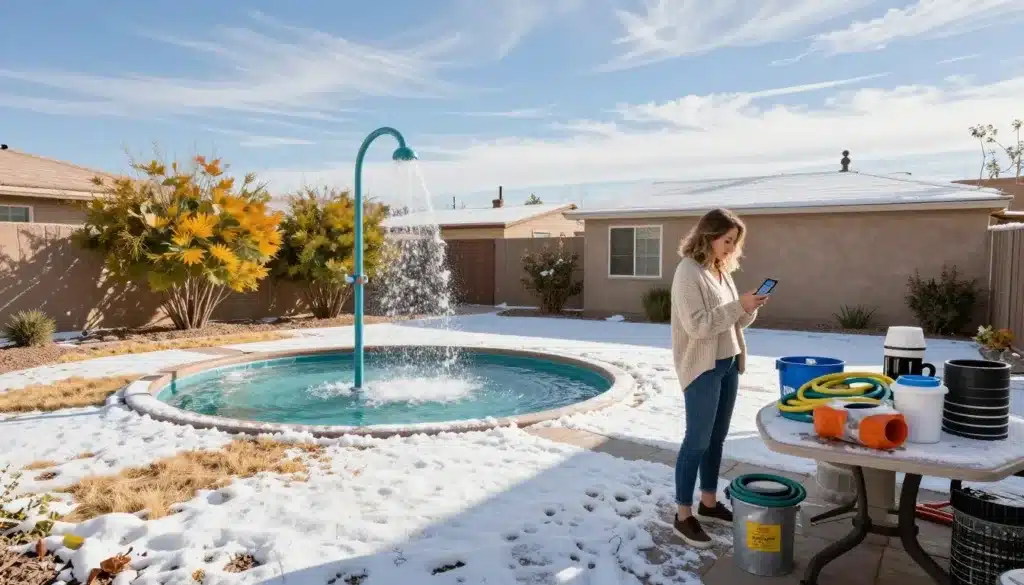
In Las Vegas, check the forecast and winterize your splash pad when colder weather arrives, draining it and preparing tarps and hoses.
Nights in Las Vegas rarely stay below freezing, so timing is about the first cold night of winter, not the whole season. Shut the system down once daytime highs stay below 70°F and nights dip near freezing. Depending on the region, that usually falls between late September and early November.
The current standard set, U.S. Climate Normals for 1991-2020, was released by NOAA in 2021.
Las Vegas Freezes Are Brief but Still Matter
Typical December and January average lows in Las Vegas are about 40°F. Those lows are mild, but a short freeze can still turn water in an undrained line into ice. Repeated freezing and thawing can widen small cracks, which causes damage over time.
Long freezes that stay below 28°F are the clearest signal to prepare. A date set by temperature trends is safer than one set by the calendar, because a warm September can still turn cold fast.
Setting the Shutdown Date
Before you pick the date, run five checks on your system. Pick a day you can keep free for the whole job, and leave a margin before the forecast turns cold.
- Check the local overnight forecast for lows near freezing.
- Check whether the pump and lines sit in exposed or shaded spots.
- Check whether the water supply runs through an outdoor run.
- Check whether you can reach the pump without a ladder.
- Check whether the electrical work needs a technician.
Set the date for the week daytime highs first stay below 70°F, and move it up if the forecast shows a night at or below 28°F.
How to Winterize a Splash Pad, Step by Step
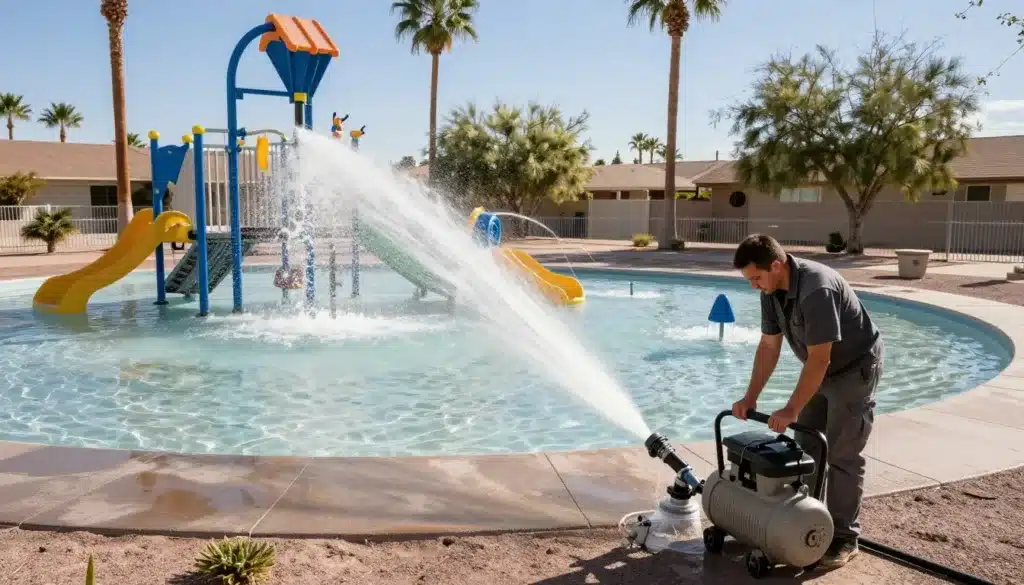
Blow all remaining water from the lines before installing winter caps, helping prepare a Las Vegas splash pad for the colder months.
Start with power and water, because a running pump or an open supply line undoes every step that follows. To winterize a water feature, shut off power and water, purge the lines, cap the nozzles, and drain the basin. Keep this order, and the job fits in one session.
Shut Off Power and Water
Turn off the main water supply and the automatic-fill system first. Disconnect the supply lines so water left in the plumbing cannot freeze and split it. Turn off the main electrical supply at the breaker before you touch the controller, timers and chemical automation.
Purge Lines and Protect Nozzles
Water expands about 9 percent when it freezes, and that force can split a pipe or damage a pump. Set the air compressor to about 40 psi, then blow out each solenoid line. Return to each line at least twice, so no water sits at a bend or valve.
Many owners close the main valve and stop, but low lines stay full and can still freeze. Purge first, and check that each line was blown out at least twice before adding antifreeze. Where a low line cannot drain by gravity, pour about 1 gallon of non-toxic RV antifreeze into it.
Remove each upward-facing nozzle, clean it, and fit a winter cap. Caps keep dirt out of the openings all winter.
Drain the Tank and Store the Pump
Keep the holding tank at least half full so ground pressure cannot make it float. Drain the feature basin, clean it with warm water, mild dish soap and a soft brush, then dry it fully before storage.
Store the removable pump in a dry, frost-free place after you clean and dry it. Chlorine loses strength over the off-season, but muriatic acid can be stored and reused the following year. Keep the rest of the equipment dry too.
Before you finish, check that every low point of the lines is empty. Trapped water there is the most common source of a split line.
Spring Startup After a Winter Shutdown
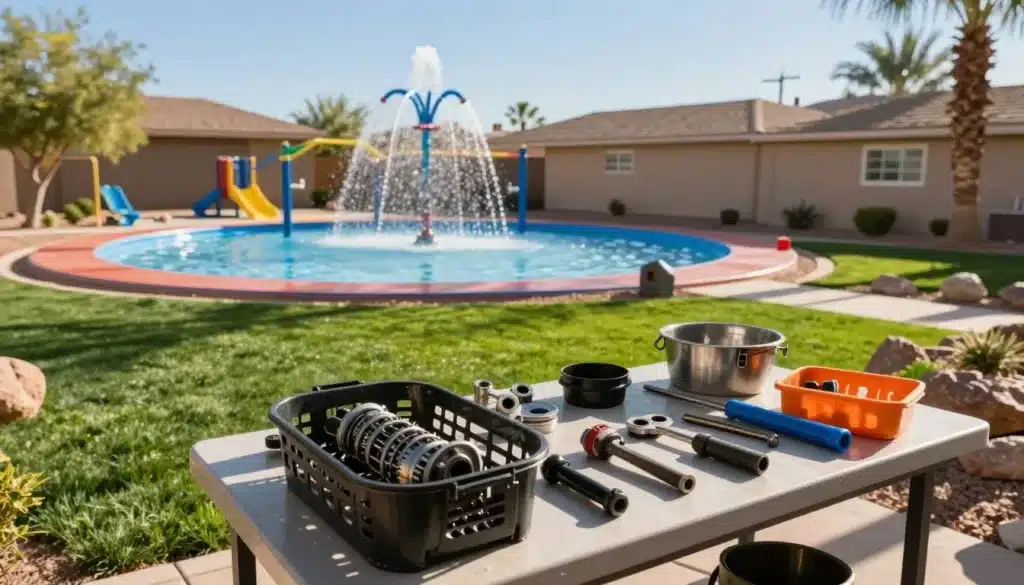
Before restarting a splash pad after winter, check the pump basket, tools, and metal parts so the system is ready for spring use.
Spring maintenance is the same steps in reverse, so start with the parts that were stored away. Inspect each one before anything is turned on. The table below lists what to check for each part.
| Part | Winter action | Spring check |
|---|---|---|
| Filter pump | Emptied and stored dry | Run first for a full day |
| Feature pump | Cleaned, dried and stored frost-free | Starts only after the filter has run |
| Nozzles and winter caps | Removed, cleaned and capped | Reinstalled and checked for debris |
| Holding tank | Kept at least half full | Float valve checked as it fills |
| Timer | Off during the shutdown | Starts 1-2 hours before the feature pump |
Run the filter pump for a full day before any features turn on, and clean the filter on the second day. Set the timer to start the filter pump 1-2 hours before the feature pump, and stop it 1-2 hours after. Those settings keep the water moving while the feature runs.
Fill both pump baskets completely before the first start. Watch the float valve on the holding tank as the water rises, then check for leaks at every fitting before the feature pump runs.
Reinstall the winter-capped nozzles, and check each one for debris before the feature pump runs. Check the check valve too, because a wrong flow direction stops the pump, so its arrow must match the pipe arrow. Call a service technician if a check fails.
If you plan new layouts for next summer, browse splash pad ideas for backyard fun first. Run the feature pump only after the filter has run for a full day, because a pump started early on a dirty filter loads the system with debris.
Conclusion
Proper winterization takes one planned session, and it saves the spring time that water line repairs would cost. Finish the shutdown before the first cold night, and the pipes and pumps stay protected through the season.
Spring startup follows the same steps in reverse, with a full filter run before the feature pump. Following that order keeps the service calls and surprises to a minimum.
Put the shutdown date on the calendar this week, and keep the table from the spring section with your stored parts. Then the spring startup is a checklist, not a search.