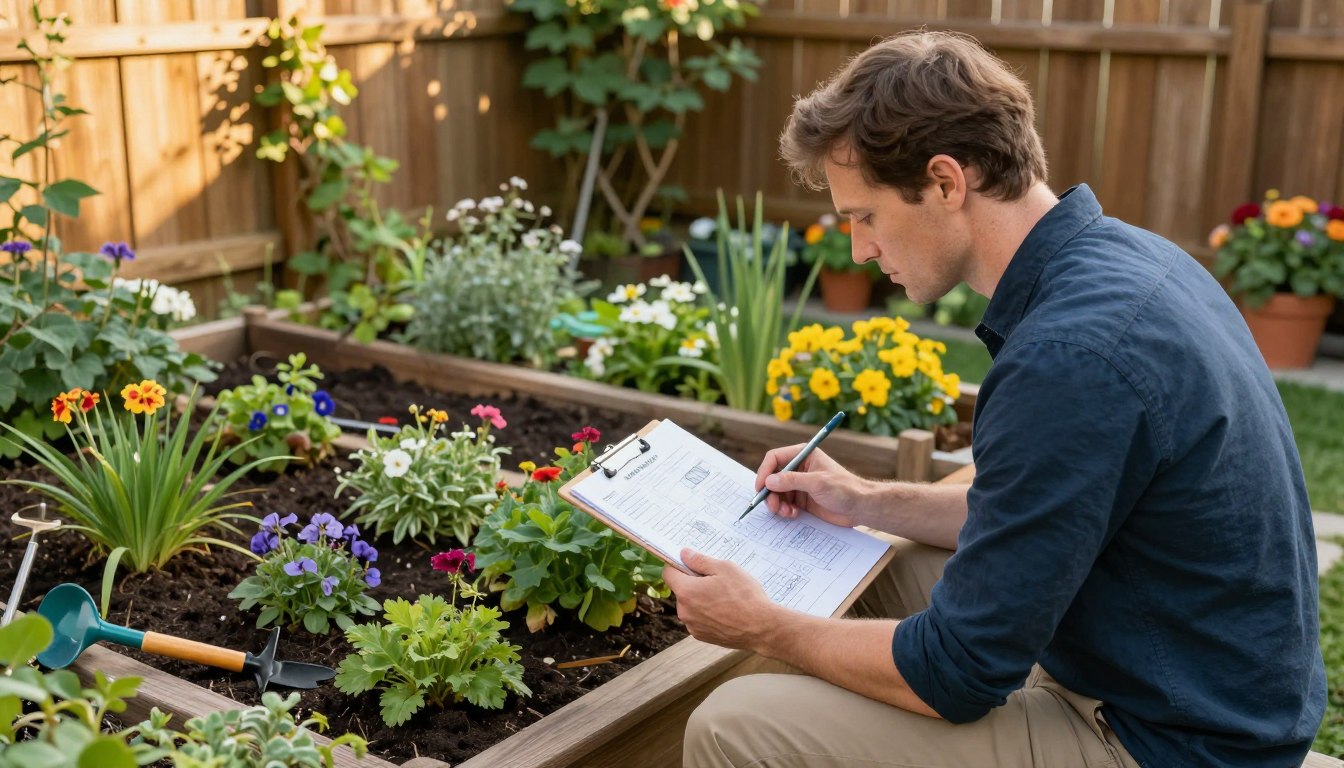
Why does a backyard putting green cost Las Vegas homeowners more per square foot than the lawn it replaces? A backyard putting green in the Las Vegas Valley usually costs about $15-$30 per square foot installed. The exact figure moves with the shape of the green, the base work and how easily crews can reach the yard.
Busy professionals often want a low-maintenance desert home, and a green fits that goal. A flat practice green is the simplest build, while a contoured green adds breaks and a fringe, the taller turf border around the putting surface. Many Las Vegas yards have room for one, and the price follows the installed square footage and the specification.
Price comes from what you ask for, not from the turf alone. Ask every installer for a written scope that lists square footage, grade, cup count and access, so two quotes can be compared line by line.
Key Takeaways
- The installed price in Las Vegas usually runs about $15-$30 per square foot.
- Installed square footage and specification set the price, not the turf alone.
- A flat practice green costs less than a contoured green with fringe.
- Request a written scope that lists square footage, grade, cups and access.
- Compare quotes line by line before you choose an installer.
Backyard Putting Green Cost in Las Vegas
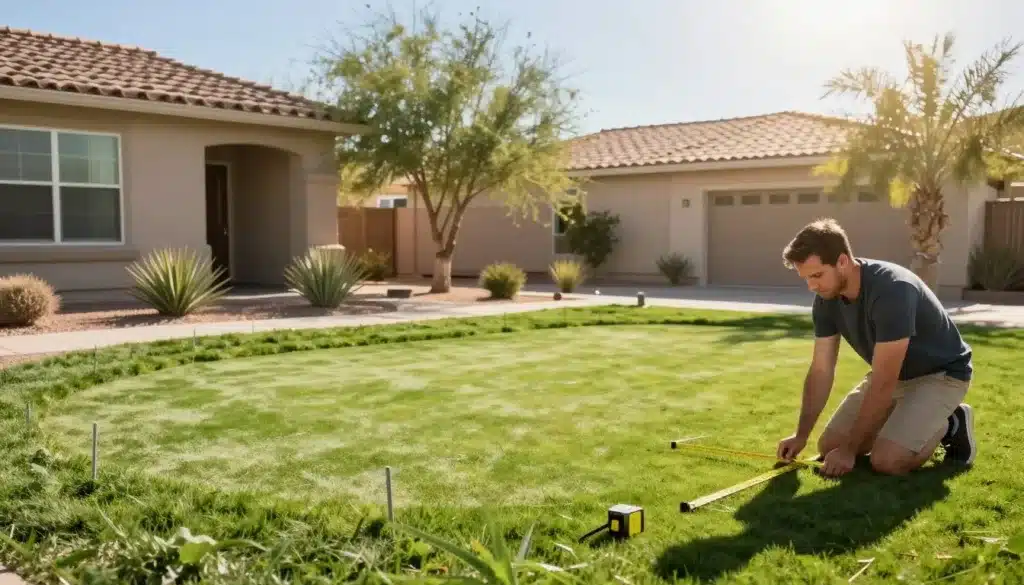
Backyard putting green costs in Las Vegas depend on the space being planned, so measuring the area is a useful first step.
A 250 square foot flat green with one cup runs about $5,000 before extras, which is the quickest way to see what a small green costs. To plan a budget, multiply the planned square feet by the installer’s per-square-foot rate, then add the extras. The putting green cost is usually quoted per square foot, so the area is the first number to pin down.
The compacted base is the layer of crushed stone or decomposed granite, packed down in lifts under the turf, that carries the surface and lets water drain away. A 450 square foot contoured green with fringe runs about $10,000-$12,500. Bunkers, chipping pads, lighting and retaining edges are billed extra.
Small greens cost more per square foot because the setup time is fixed, yet the total still falls as the area falls. A lump-sum quote tells you little, so ask for the square footage in writing. Then check whether the quote includes fringe, cups and grading, since those lines most often differ between quotes.
What Moves the Price of a Putting Green
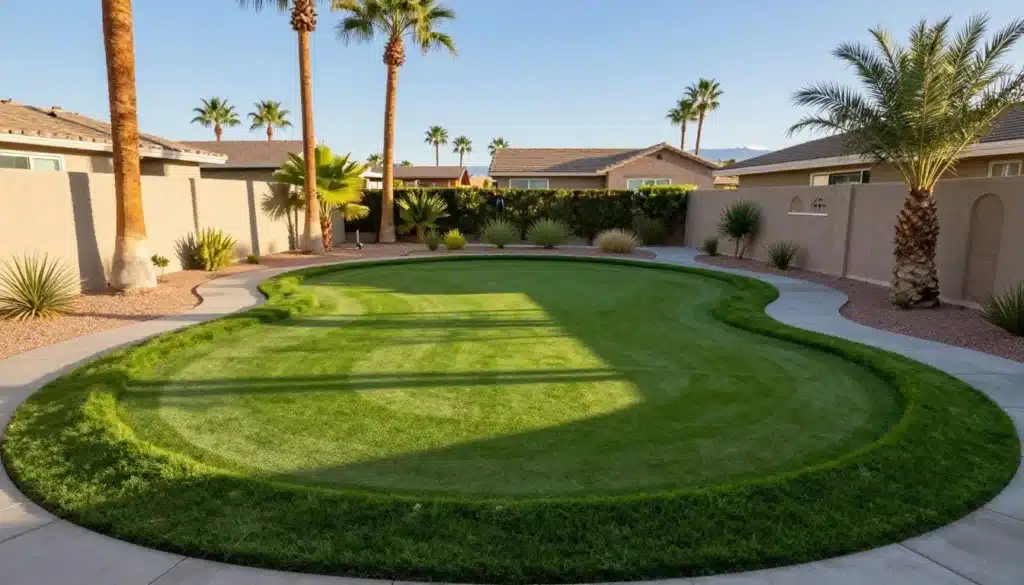
A contoured green with gentle breaks and a lush fringe shows how design choices shape the cost of a backyard putting green in Las Vegas.
Each break, tier and cup location is built into the base, which is why the design affects price as much as the square footage. The shape must be formed in the compacted base before any turf goes down. A complex layout asks for more grading, more hauling and more labor.
Base work often makes up about 40-55% of the total project cost. That makes the base the largest line on most quotes, and a golf-style green needs the same careful grading as a course.
Contours, Fringe and Cups
Fringe installation runs about $4-$8 per square foot, so a green with a wide fringe costs more than a flat one. Each cup needs a stable liner set at the right depth. Moving a cup later means digging out the spot and rebuilding it, so plan the cup locations before the crew starts.
Base Work and Drainage on Desert Soil
Caliche layers and monsoon rain make drainage a real concern in the Las Vegas Valley. A typical compacted base is 3-4 inches of compacted aggregate with a 1-2% slope that sheds water. Water that ponds on the surface ruins play and turf, even on a green that looks flat and fine.
When a site needs one, a drainage pipe system adds about $300-$900 per system. Good grading costs time, but it protects the whole investment.
Site Access, Old Surfaces and Add-Ons
Walled and hillside lots in Anthem, Seven Hills, MacDonald Ranch, McCullough Hills and Summerlin often need base material moved by hand. That hand work adds labor before the base can start. Removing grass, concrete or old landscape fabric adds more work, and bunkers, chipping pads, netting and lighting are priced separately.
Before signing, ask for the base depth and drainage plan in writing. The base is the hardest part of the job to fix later.
How a Putting Green Compares With an Artificial Lawn
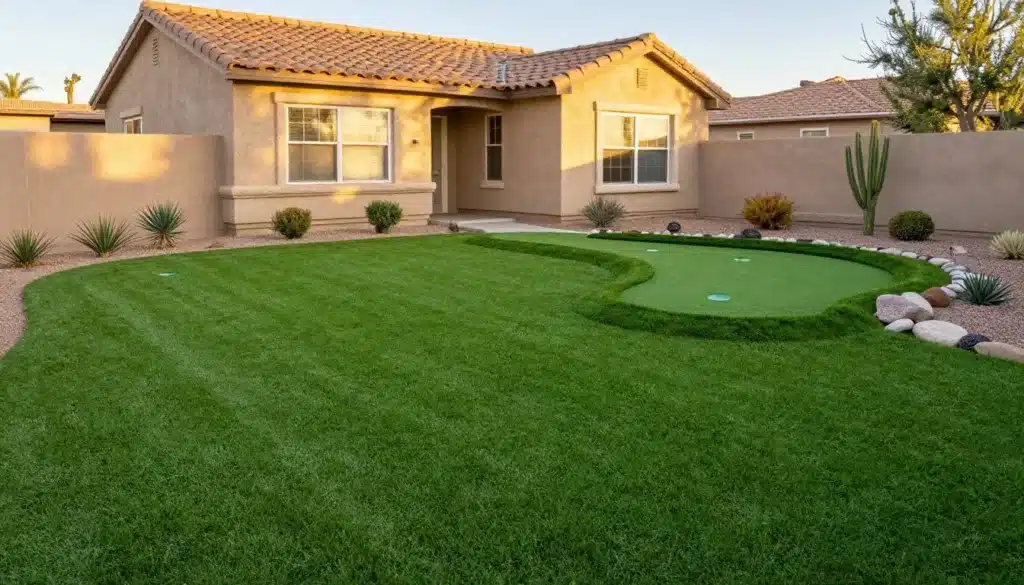
Artificial turf covers more of the yard, while a putting green adds a dedicated space for practice, as this Las Vegas backyard illustrates.
A putting green usually costs about 1.5 to 2 times as much per square foot as artificial turf laid as a lawn. Artificial lawn turf installed in this market often clusters near $8-$15 per square foot, so the green’s rate sits well above it.
| Surface | Typical installed cost | What drives the difference |
|---|---|---|
| Artificial lawn turf | $8-$15 per square foot | Lawn tolerates minor waves over a simpler base |
| Backyard putting green | About 1.5 to 2 times the lawn per-square-foot figure | Precision grading and dense short-pile turf that must roll true |
| Small green beside a large lawn | Lower total spend | Fewer square feet to cover, even at a higher rate |
The gap comes from the job itself. A lawn tolerates minor waves over a simpler base, but a green must roll true, so its base is graded more precisely and its turf is a denser short-pile product. Natural grass needs regular watering, while artificial turf needs little. Replacing nonfunctional grass with drip-irrigated desert plants saves water, because outdoor water is used once and is not returned to Lake Mead. For a full-lawn comparison, see our guide to artificial turf installation cost in Las Vegas.
The wider case for synthetic turf, from low upkeep to low water use, is laid out in benefits of switching to synthetic turf. A small green can still cost less in total than a large lawn, since it covers fewer square feet even at the higher rate.
Do not accept a lawn-grade turf for the putting surface, even when it lowers the quote. Low-density landscape turf is not built for ball roll or durability, and the difference shows within a season.
DIY Kits Versus Professional Installation
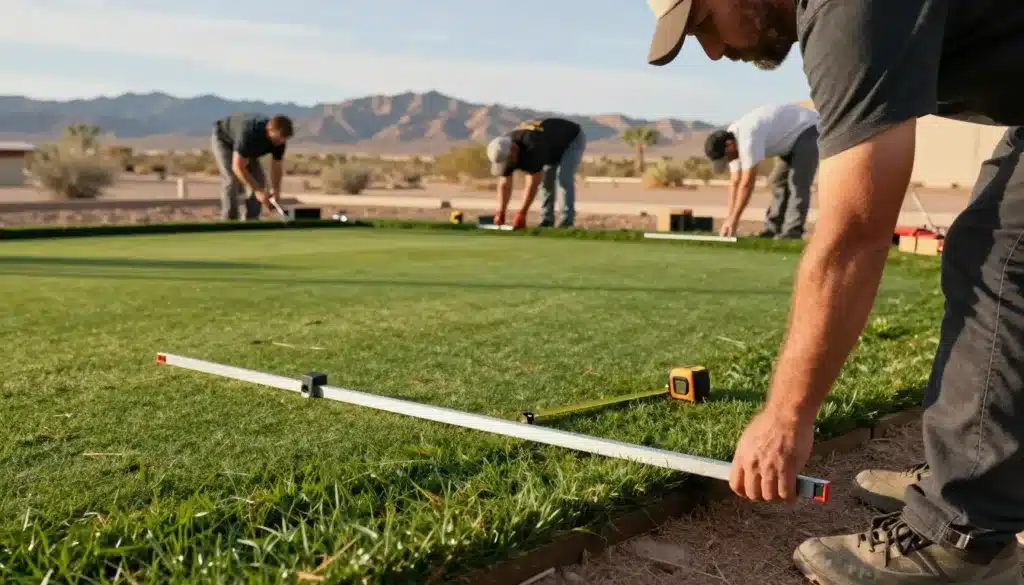
DIY kits can reduce installation costs, while professional work helps ensure a level base, as these Las Vegas landscapers demonstrate.
A DIY green in Las Vegas typically runs $6-$12 per square foot for materials and tools, and professional labor is usually billed on top of that. Installing a putting green in a backyard starts with preparing the base, then laying and seaming the turf.
Turf materials run about $3-$8 per square foot, and the tools alone usually total about $280-$500. Professional labor adds about $6-$10 per square foot. Base preparation is where a DIY budget most often goes wrong, so these steps show the usual costs:
- Excavation and debris removal: about $0.50-$1 per square foot
- Crushed stone or decomposed granite: about $1-$2 per square foot
- Compaction and leveling: about $1-$1.80 per square foot
- Weed barrier: about $0.20-$0.50 per square foot
Skip the DIY route for large greens and greens on slopes, which need professional leveling. Soft clay soils raise the risk of sinking. A kit usually has basic turf and minimal base work, which shows up as bumps and uneven breaks.
Test the base with a long straightedge before laying any turf. A dip found at that stage is cheap to fix, but expensive to fix after seaming.
Heat, Sun and Surface Choices for Las Vegas Yards
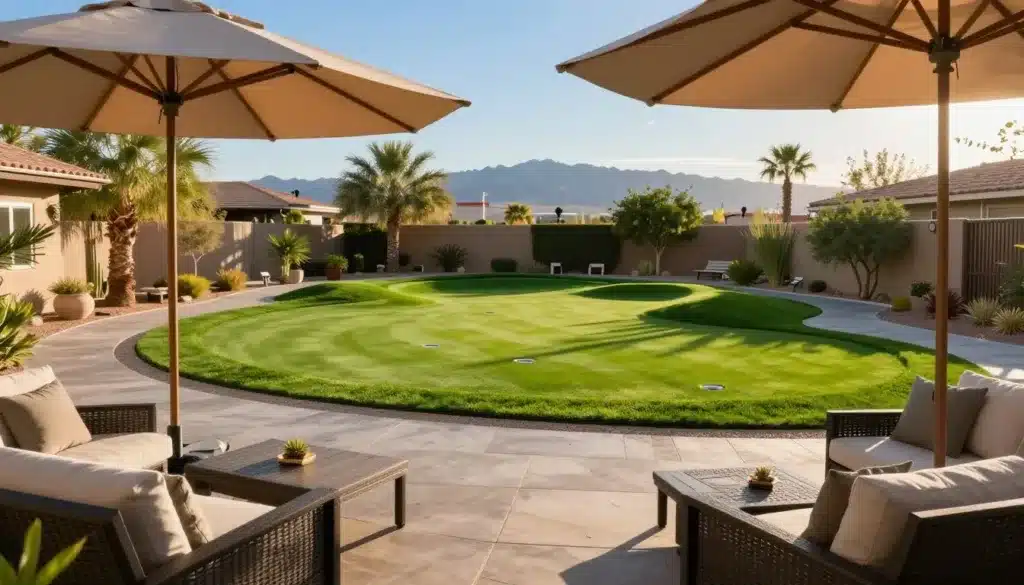
Las Vegas heat and sun make shade and surface choices essential for a backyard putting green, with a shaded patio offering a comfortable place to relax nearby.
The heat numbers for artificial turf are high enough that siting the green is as important as choosing the turf. In one set of observations, green artificial turf reached a maximum temperature about 69 degrees F higher than irrigated natural grass. It also ran about 62 degrees F above air temperature.
Surface temperatures reached as high as 169 degrees F in observations made between August 2006 and March 2007. A surface that hot is not comfortable to stand on at midday. Sun exposure decides how hot the pad gets, so a shaded pad stays usable longer than one in full sun.
Use these checks when you plan the pad:
- Orient the pad to use shade from a wall, tree or structure in the afternoon
- Specify UV-stable turf in writing for full-sun west exposures
- Measure how many hours of direct sun reach the pad in July
- Schedule summer practice for early morning or evening
Heat also changes the turf, which can affect ball roll. Put a shaded spot beside the green from the start, since a summer session at midday is hard to enjoy without one.
Las Vegas Rebates and Water Rules That Can Offset Cost
A rebate can offset part of a grass-replacement project, but only if the paperwork comes before any grass comes out. The rebate pays for functional turf removed, so it can lower the cost of a green built in that space. The rules below decide whether a project qualifies.
Rebate Rates and Eligibility
Southern Nevada rebates pay by the square foot of functional turf replaced. A project needs at least 400 square feet, but a smaller project qualifies when all turf in the front or back yard being converted is replaced.
| Rebate part | Rate | Condition |
|---|---|---|
| Base rebate for the first 10,000 square feet of qualifying functional turf | $5.00 per square foot | Residential applications submitted on or after September 18, 2025 |
| Base rebate beyond 10,000 square feet | $2.50 per square foot | Same application date |
| Added amount for eligible Las Vegas Valley Water District customers | $2.00 per square foot of qualifying functional turf removal | Single-family applications submitted on or after January 1, 2025 |
Plant Coverage and Surface Rules
A green alone with no plants does not meet the rule that living plants cover at least 50% of the converted area at maturity. The rebate depends on the whole converted area, so plant beds belong in the plan from the start. Permeable artificial turf counts as surface cover, while plastic sheeting and concrete do not.
The 2027 limit on irrigating nonfunctional grass applies to commercial, multifamily and government properties. It does not reach grass in single-family homes.
Timeline and Paperwork
Written authorization must arrive after the pre-conversion inspection and before any grass is removed. Removing grass earlier makes the project ineligible, so do not remove turf or start the green before that approval. The conversion must be completed within 12 months of the pre-conversion inspection. The signed conservation easement is due within 18 months of the program agreement’s execution.
Ask for the pre-conversion inspection date before ordering turf, so the schedule starts from a known day.
Yearly Upkeep for a Putting Green
A synthetic green typically needs about $50-$300 a year in routine upkeep, with most of that going to brushing and occasional seam repair. Most putting greens need no mowing, watering or fertilizing. Like a golf green, the surface still needs steady ball speed, and that depends on care.
Silica sand infill, added at about 1-2 pounds per square foot, holds the fibers upright and keeps ball speed steady. Skipping infill is a common mistake, since a green without it ages faster and loses that steady speed. Water that pools on the green usually points to drainage or base leveling, not the turf, so check the base before adding more infill.
Routine yearly costs break down like this:
- Light brushing, monthly: $0-$150 per year
- Leaf blowing: $0-$80 per year
- Infill top-up, optional: $50-$150 per year
- Seam repair every 3-5 years: $100-$250
Check the seams after heavy wind, since seams are the first place wear shows.
Conclusion
A backyard green in Las Vegas is priced by its installed area, its base and its extras, so a per-square-foot rate alone does not tell the whole story. Plant coverage and paperwork decide whether a rebate applies, so settle both before any grass comes out.
Measure the yard, sketch the green with its cups and fringe, and request a written scope before committing to a build date.