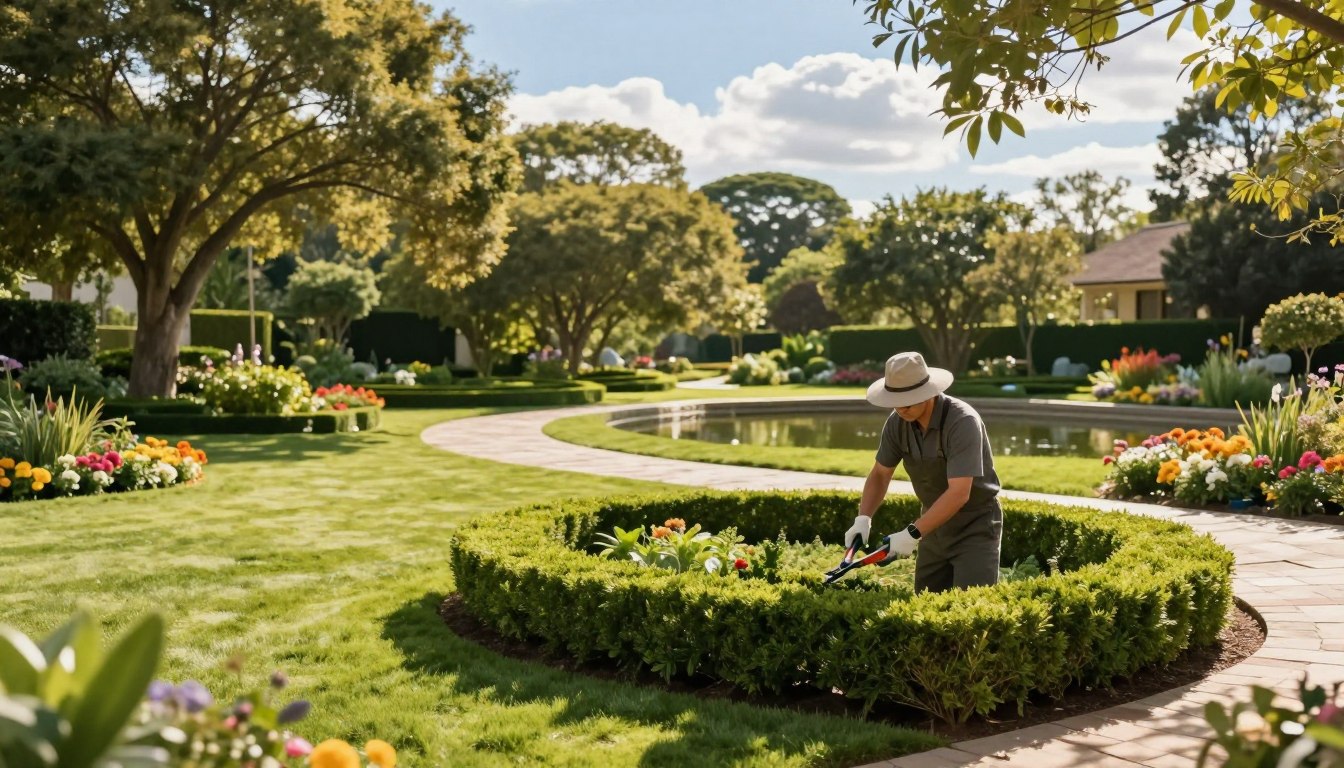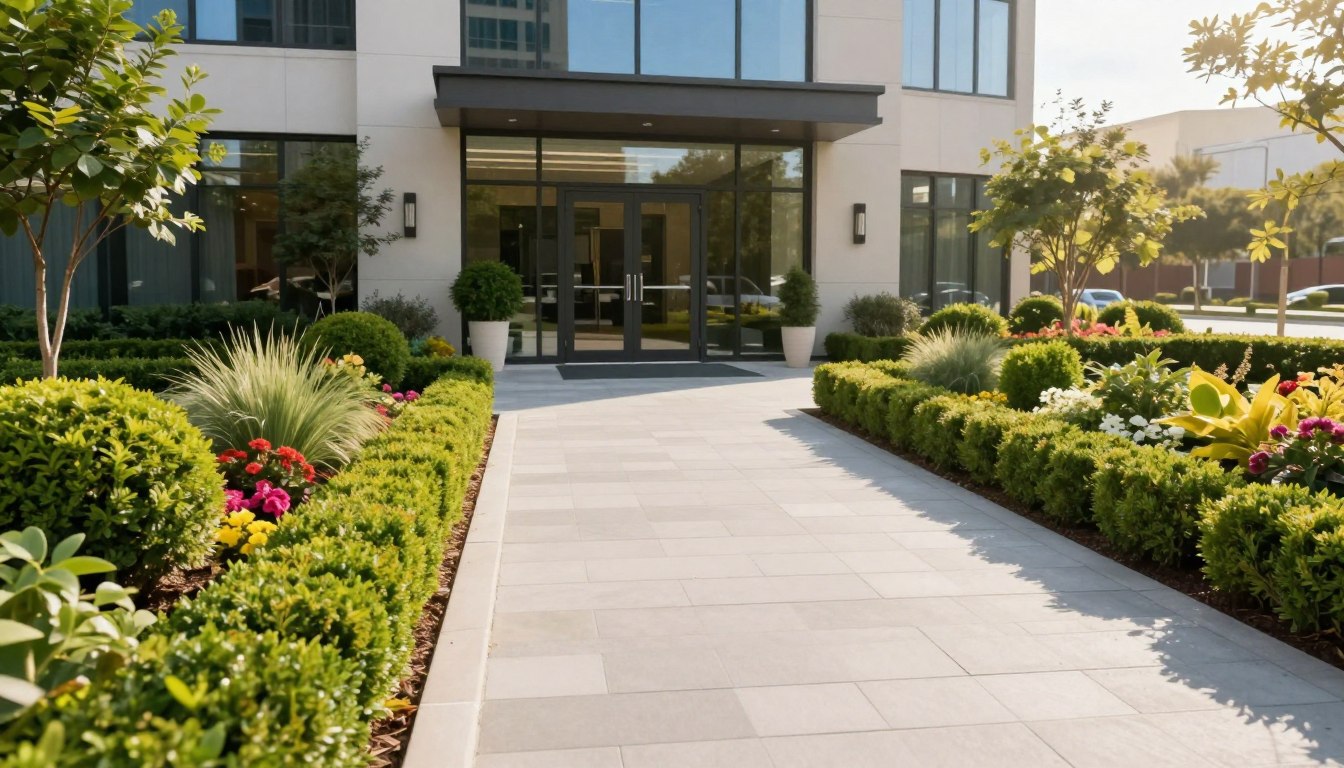
A scope-by-scope guide for HOA boards, shopping center owners and multi-family property managers — including what changes on 1 January 2027.
Commercial landscape maintenance in Las Vegas covers irrigation inspection and repair, desert plant and tree care, structural pruning, granite and mulch refresh, weed control, drainage clearing after monsoon storms, and seasonal irrigation-clock resets to match the Southern Nevada Water Authority’s mandatory watering schedule. Mowing is a minor line item here. Irrigation is the major one.
Most commercial landscape maintenance contracts sold in Las Vegas are written from a national template. They lead with mow-blow-and-go frequencies, price by the visit, and treat irrigation as a call-out item. In the Mojave Desert that gets the priorities backwards. A Las Vegas commercial property loses plant material to a failed drip emitter long before it loses anything to an unmowed lawn — and after 1 January 2027, a lot of those lawns will not legally exist.
This guide breaks down what a maintenance scope should actually cover on four property types: HOA common areas, shopping centers and retail, multi-family housing, and office or industrial sites. It is written for the person who has to approve the contract.
Why 2027 changes every commercial scope in the valley
Nevada Assembly Bill 356 prohibits the use of Colorado River water to irrigate nonfunctional turf, beginning in 2027, on property that is not zoned exclusively for a single-family residence. The Southern Nevada Water Authority describes the law as applying to “commercial, multi-family, government and other properties.” It does not apply to grass in homeowners’ yards, to cemeteries, or to grass used for recreation at schools and parks.
Two different dates matter, and they are routinely confused:
- 31 December 2026 — the City of Henderson states that nonfunctional, decorative grass must be removed by this date.
- 1 January 2027 — the date the water-use prohibition itself takes effect. From that day, Colorado River water may not be used to irrigate nonfunctional turf on covered property.
Nonfunctional or decorative grass means an irrigated grass area that provides no functional use: turf along streets, streetscape sidewalks, driveways and parking lots, in medians and roundabouts, and frontage, courtyard and building-adjacent turf on property not zoned exclusively for single-family residences. Turf in HOA-managed areas that provides no recreational benefit to the community is covered regardless of zoning. Functional turf — active recreation areas, athletic fields, playground turf — is treated differently, and a waiver can be applied for through SNWA.
SNWA states plainly that removing a lawn without its approval makes the conversion ineligible for the Water Smart Landscapes rebate. The required order is: apply, wait for the pre-conversion inspection, then remove. SNWA also warns that waits for spring and fall site visits can be long.
A property manager who reads the 31 December 2026 deadline, sends a crew out next week and pulls the turf has just forfeited $5.00 per square foot on the first 10,000 square feet. On a 12,000 square foot streetscape conversion that is a five-figure mistake made in a single afternoon.
If your property still has decorative turf, the conversion is a capital project with its own timeline — not a maintenance item. Taylormade Landscapes covers the application sequence, rebate requirements and waiver criteria in detail on our AB 356 turf removal guide for Las Vegas HOAs, and the rebate mechanics on our SNWA turf rebate page. What belongs in your maintenance contract is everything that happens afterwards — and that is what the rest of this guide covers.
The core scope: what every commercial contract should list
A defensible Las Vegas commercial scope has seven service areas. If a bid you are comparing is missing one of them, it is not cheaper — it is smaller.
| Service area | What it covers | Typical frequency | Why it matters in the Mojave |
|---|---|---|---|
| Irrigation inspection | Zone-by-zone run test, emitter check, pressure-regulator and filter check, leak detection, head alignment on any remaining spray | Monthly, minimum | A clogged emitter kills a shrub silently. You find out six weeks later when it is already dead and the replacement is billable. |
| Irrigation clock resets | Reprogramming controllers at each of the four SNWA seasonal changeovers; verifying assigned watering group and days | 4× per year, dated | Assigned watering groups are mandatory for all municipal water customers. Watering off-schedule may result in a water-waste fee or citation. |
| Tree care | Structural pruning, canopy thinning for wind, stake removal, deep-root watering checks, heat-stress monitoring | Quarterly inspection; pruning 1–2× per year | Mature desert canopy is the most expensive asset on the property and the slowest to replace. |
| Shrub and groundcover care | Selective hand pruning, deadwood removal, replacement of failed plants, maintaining mature plant coverage | Monthly to quarterly | Rebated conversions must keep at least 50% living plant cover at maturity. Shearing everything into balls reduces coverage. |
| Weed control | Pre-emergent applications, mechanical removal, spot treatment in granite and decomposed-granite beds | Pre-emergent 2–3× per year; removal monthly | Weeds in a converted desert bed are a visual-compliance and curb-appeal problem, not an agronomic one. |
| Granite, mulch and surface | Raking, top-dressing, redistributing washout, maintaining uniform permeable cover | Quarterly; after every major storm | Rebated areas must keep uniformly permeable surface cover. Plastic and concrete are not permitted. |
| Storm and drainage response | Clearing inlets, swales, curb cuts and basins; removing debris; regrading washouts | Within 48 hours of a monsoon event | Monsoon runoff moves granite, buries emitters and floods parking areas. Nothing in a national template covers it. |
Table 1. Core commercial landscape maintenance scope for a Las Vegas valley property.
Two of those rows carry most of the cost and most of the risk. Irrigation on a commercial site behaves differently from irrigation on a house — more zones, longer laterals, controllers nobody has opened in years, and lines that were cut during a resurfacing project and spliced badly. We break down how to audit and optimise a multi-zone commercial system in how to optimise your commercial irrigation services. Weed control is the other: in a converted desert bed, pre-emergent timing does more than any amount of pulling, and the weed prevention sequence we use on maintenance accounts is the same one that applies to granite beds on a shopping centre perimeter.
Scopes by property type
HOA common areas
HOA landscape maintenance is the most procedurally complex of the four, because the board answers to owners and to the architectural committee at the same time. A scope written for an HOA should be explicit about three things a commercial scope can leave vague.
First, the boundary. Name the common-area parcels, the streetscape strips, the entry monuments and the retention basins, and state in writing which side of the sidewalk belongs to the association and which belongs to the homeowner. Most mid-contract disputes in HOA work are boundary disputes.
Second, the approval path. Plant substitutions, irrigation retrofits and any change to the streetscape palette usually need architectural committee sign-off. The contract should state who prepares the submittal. Taylormade Landscapes produces 2D and 3D CAD drawings for exactly this purpose — a board approves a rendering far faster than it approves a written description.
Third, the reserve-study linkage. Irrigation controllers, valves and mainline have finite lives. A maintenance contract that reports failures without reporting remaining service life leaves the board budgeting blind. Ask for an annual asset condition note, not just a service log.
Shopping centers and retail
Retail landscape maintenance is judged from a car at 25 miles per hour, which changes the priorities. Sightlines at the driveway aprons, canopy clearance over parking stalls and the pedestrian path from the far spaces to the door are the three things that actually affect tenants.
Shopping center scopes should carry a parking-lot island schedule separate from the perimeter. Islands take the worst of it: reflected heat from asphalt on three sides, vehicle damage, trash, soil compaction, and irrigation that was laterally cut during a resurfacing project years ago and never properly repaired. They need their own inspection line and their own plant-replacement allowance.
They should also specify canopy clearance height over drive aisles and stalls. Vague “as needed” pruning becomes an argument the first time a delivery truck clips a mesquite.
Multi-family housing
Multi-family sits between the two. It has resident-facing amenity areas that need the attention of an HOA scope, and high-traffic circulation that needs retail-grade durability. Two line items matter disproportionately: dog-run and pet-area maintenance, which drives both complaints and odor issues in synthetic turf, and trash enclosure surrounds, which are the first thing a prospective tenant sees and the last thing anyone budgets for.
Multi-family properties are also covered by the 2027 nonfunctional turf prohibition. Resident recreation areas may qualify as functional — that is what the SNWA waiver process is for — but decorative frontage and streetscape turf will not.
Office and industrial
The lowest-touch of the four and the easiest to over-service. Office and industrial scopes should strip out amenity-level detail and concentrate on entry impression, irrigation integrity and liability: clear sightlines, no trip hazards from root heave or settled granite, and functioning drainage across large impervious areas. Frequency can drop. Irrigation inspection cannot.
The Mojave line items a national scope sheet misses
These are the items that separate a Las Vegas contract from a Phoenix template or a national rollup’s standard form.
- Caliche awareness in replacement planting. Much of the valley sits on caliche — a cemented hardpan layer that holds water in the planting pit like a bathtub. Replacing a dead shrub by digging a hole exactly the size of the root ball into caliche produces another dead shrub. The scope should require that replacement pits be broken through or drained, and that the crew report where caliche is found.
- Hard-water emitter maintenance. Southern Nevada water is hard, and mineral scale is the single most common cause of drip emitter failure here. Emitters need periodic flushing and replacement on a cycle, not on failure. SNWA’s rebate terms require emitters rated at 20 gallons per hour or less, with a filter and pressure regulator in the system — worth matching across the whole property, not only the rebated portion. If the property still runs spray heads on beds, the mechanics of changing them over are covered in converting sprinklers to drip lines.
- Monsoon drainage response. Southern Nevada’s heaviest rain arrives in short, intense summer storms. A maintenance contract should carry a defined post-storm response window and name what gets checked: inlets, curb cuts, swales, basin outlets, and any granite that has migrated into them. Where a property has graded slopes or retention basins, the same storm that buries emitters strips the surface — our notes on landscaping sloped ground without erosion problems apply directly to basin banks and parking-lot berms.
- Wind pruning for canopy structure. Spring and autumn wind events off the Spring Mountains take out trees that were never structurally pruned and were left staked too long. Canopy thinning and timely stake removal are cheap. Replacing a 15-year-old tree is not.
- Summer irrigation timing compliance. From 1 May through 31 August, SNWA restrictions prohibit landscape irrigation between 11 a.m. and 7 p.m. Any mid-day syringing or hand-watering a crew does in July needs to be inside the exemption for hand-watering and supervised system testing, which SNWA says requires contacting your water utility for details.
- Reflected heat zones. Plant material against a west-facing stucco wall, a parking island or a block wall lives in a different microclimate than the same species 20 feet away. A good scope prices plant replacement by zone, not by a flat per-plant rate across the property.
- Tree heat stress monitoring. Canopy loss is cumulative and easy to miss until a summer kills three trees at once. Quarterly arborist inspection catches declining crowns, girdling roots and irrigation that no longer reaches a maturing root zone. International Society of Arboriculture membership is a reasonable credential to ask any bidder for when mature trees are on the property. Species choice matters as much as care: our list of the best shade trees for Las Vegas covers which ten actually hold up through a valley summer, which is the question that decides a replacement budget.
The Mojave maintenance calendar
The SNWA watering schedule is the spine of the year. Everything else hangs off it.
| Period | SNWA irrigation rule | Maintenance priority |
|---|---|---|
| 1 Nov – 28 Feb | One assigned day per week | Reset all controllers by 1 November. Structural tree pruning while deciduous trees are dormant. Pre-emergent before winter weed germination. Backflow and valve inspection. |
| 1 Mar – 30 Apr | Three assigned days per week | Reset controllers by 1 March. Full zone-by-zone irrigation audit before heat arrives — this is the single most valuable visit of the year. Spring pre-emergent. Plant replacement window. |
| 1 May – 31 Aug | No landscape irrigation 11 a.m. – 7 p.m. | Reset controllers by 1 May. Weekly emitter spot-checks through peak heat. Canopy thinning before monsoon wind. Post-storm drainage response. Minimal pruning — cutting in extreme heat stresses plants. |
| 1 Sep – 31 Oct | Three assigned days per week | Reset controllers by 1 September. Post-monsoon repair: regrade washouts, replace buried emitters, top-dress granite. Autumn planting window. Assess summer losses and budget replacements. |
Table 2. Sprinkler watering on Sunday is prohibited in every period. Assigned watering groups are mandatory for all municipal water customers; check your monthly water bill or snwa.com for your group.
The highest-value visit of the year is the March irrigation audit. Running every zone, checking every emitter and correcting pressure before the first 100-degree week is what decides how much plant material you replace in September. A contract that does not name this visit explicitly is leaving your largest annual cost to chance.
What a commercial maintenance contract should specify
Twelve items. If a proposal is silent on any of them, ask before you sign — the gaps are where change orders live.
- Scope boundary — a map or parcel list, not a property name.
- Visit frequency per service area — separately for irrigation, trees, shrubs and surface, not one blended number.
- Irrigation inspection method — zone-by-zone run test, or a visual walk? These are not the same service.
- Seasonal clock resets — named as four dated events tied to the SNWA calendar.
- Repair threshold — the dollar figure below which repairs are included and above which they are quoted.
- Plant replacement — who pays, under what conditions, and whether there is an annual allowance.
- Warranty on replacements — [CLIENT INPUT NEEDED — Taylormade’s commercial plant-replacement warranty term]
- Post-storm response window — in hours, with a defined checklist.
- Reporting — photo-documented service log, plus an annual asset condition note for reserve planning.
- Licensing and insurance — Nevada State Contractors Board licence number, general liability limit and workers’ compensation certificate. What to verify and how is set out in how to choose a licensed landscape company in Las Vegas. [CLIENT INPUT NEEDED — Taylormade licence number and coverage limits]
- Water-waste liability — who is responsible if a controller is left on the wrong schedule and the property receives a citation.
- 2027 compliance status — a written statement of whether any turf on the property is nonfunctional under AB 356, and a plan with dates if it is.
Five red flags when comparing bids
- Mowing frequency as the headline. On a converted desert property there is very little to mow. A bid organised around mow cycles was not written for this property.
- Irrigation as a call-out item. If inspection is not in the base scope, every emitter is a billable visit — and nobody finds a clogged emitter by driving past.
- No named seasonal reset dates. Four resets per year, on the SNWA calendar. If they are not in the contract, they will not happen, and the citation is yours.
- A flat per-plant replacement rate. A one-gallon groundcover and a 24-inch box tree are not the same risk. A flat rate means the contractor is pricing for the cheap case and will quote the expensive one.
- Turf conversion promised inside the maintenance fee. A rebated SNWA conversion requires an application, a pre-conversion inspection, a notarised Authorized Signer Agreement, a conservation easement recorded with Clark County, and completion within 12 months of the inspection. That is a capital project. Anyone folding it into a monthly maintenance number has not read the terms.
Doing the 2027 timeline maths
This is the part most boards have not yet worked through. Assume a property with 12,000 square feet of decorative streetscape turf that has not yet applied.
The rebate pays $5.00 per square foot on the first 10,000 square feet and $1.50 per square foot thereafter for business, HOA and multi-family customers, plus $100 per new qualifying tree installed. Conversions must be at least 400 square feet, reach at least 50% living plant cover at maturity, run on drip irrigation with a filter and pressure regulator, and be surfaced with uniformly permeable mulch — no plastic, no concrete. A conversion area above 10,890 square feet (a quarter acre) requires planning approval. Removal must not begin before the pre-conversion inspection. Completion and the inspection request are due within 12 months of that inspection.
So the sequence is: application, then a wait for the site visit that SNWA itself warns can be long in spring and autumn, then design and architectural approval if an HOA is involved, then the work, then inspection, then the easement recording, then payment. The water-use prohibition starts 1 January 2027. The arithmetic no longer leaves room to start the application in the second half of 2026 and expect to be finished and paid before the deadline.
Two things follow. One: if the application is not already in, the realistic plan is to apply now, document the application, and treat the removal deadline as a compliance conversation with your water agency rather than something you can still beat cleanly — the SNWA Board may approve an extension or a waiver. Two: the enrolled bill also permits using alternative sources of water to irrigate nonfunctional turf on and after 1 January 2027. That is a narrow option, not a general escape, but for a property with an alternative supply it is worth asking about.
SNWA’s own business terms state that receiving a Water Smart Landscapes rebate payment does not constitute compliance with Assembly Bill 356. Taking the rebate and completing the compliance obligation are two separate matters. Treat them separately in your board minutes.
Frequently asked questions
What does commercial landscape maintenance include in Las Vegas?
It includes monthly zone-by-zone irrigation inspection and repair, four seasonal irrigation-clock resets matched to the SNWA watering calendar, tree structural pruning and heat-stress monitoring, selective shrub and groundcover pruning, pre-emergent and mechanical weed control, granite and mulch top-dressing, and post-monsoon drainage clearing. On a converted desert property, irrigation is the largest component and mowing is a minor one.
Does AB 356 apply to my HOA or commercial property?
The prohibition applies to nonfunctional turf on property not zoned exclusively for a single-family residence, which SNWA describes as commercial, multi-family, government and other properties. It does not apply to grass in homeowners’ yards, cemeteries, or grass used for recreation at schools and parks. Turf in HOA-managed areas that provides no recreational benefit to the community is covered regardless of zoning.
How much is the SNWA rebate for an HOA or commercial turf conversion?
For business, HOA and multi-family customers, the Water Smart Landscapes rebate pays $5.00 per square foot for the first 10,000 square feet converted and $1.50 per square foot thereafter, plus $100 per new qualifying tree. SNWA states the rate is subject to change and is paid at the rate in effect when the project is complete. Confirm current terms at snwa.com before budgeting.
Can we remove the grass first and apply for the rebate afterwards?
No. SNWA states that removing a lawn without its approval makes the conversion ineligible, and instructs applicants not to remove existing turf until the Authority has completed a pre-conversion inspection and authorised the work. Apply first, wait for the site visit, then remove.
How often should commercial irrigation be inspected in the Las Vegas valley?
Monthly at minimum, with a full zone-by-zone audit in March before peak heat and a repair pass in September after monsoon season. Hard water scales drip emitters, and a blocked emitter produces no visible symptom until the plant is already in decline, so inspection has to be scheduled rather than triggered by a complaint.
What are the Las Vegas watering restrictions for commercial properties?
Assigned watering groups are mandatory for all municipal water customers. Landscape irrigation is limited to one assigned day per week from 1 November through 28 February, three assigned days per week from 1 March through 30 April and from 1 September through 31 October, and is prohibited between 11 a.m. and 7 p.m. from 1 May through 31 August. Sprinkler watering on Sunday is prohibited. Watering outside assigned days may result in a water-waste fee or citation.
How can an HOA reduce heat stress on its trees?
Start with a quarterly arborist inspection to identify declining crowns, girdling roots and irrigation that no longer reaches a maturing root zone. Thin canopies for wind rather than topping them, remove stakes on schedule, extend drip emitters outward as root zones expand, and replace losses in the autumn planting window rather than in summer. SNWA’s rebate program also pays $100 per new qualifying tree, which makes canopy expansion partly self-funding on a converting property.
Who maintains the landscaping between the sidewalk and the street in an HOA?
It depends on the recorded plat and the CC&Rs, which is why a maintenance contract should name parcels and boundaries rather than a property name. In many Las Vegas valley associations the streetscape strip is common area maintained by the HOA even where it fronts individual lots — and those streetscape areas are precisely the ones most likely to be classed as nonfunctional turf under AB 356.
Where to read next
If you are working through a scope or a 2027 compliance question, these cover the pieces this guide only summarises:
- Optimising commercial irrigation services — auditing a multi-zone system, controller programming and where commercial systems usually fail.
- Converting sprinklers to drip lines — the retrofit itself, including the filter and pressure-regulator requirements a rebated conversion has to meet.
- Water-smart irrigation — scheduling and efficiency once the system is in.
- Best shade trees for Las Vegas — species that survive valley summers, which decides your replacement budget.
- Preventing weeds on a maintenance account — pre-emergent timing for granite and desert beds.
- Sloped ground and erosion — applies to basin banks, berms and graded perimeters.
- Checking a landscape contractor’s licence — what to verify before signing.
- AB 356 turf removal for Las Vegas HOAs and the SNWA turf rebate — the conversion and the rebate sequence, step by step.
Taylormade Landscapes maintains commercial, HOA and multi-family landscapes across the Las Vegas valley and has done since 2006. Our landscape maintenance and irrigation services pages set out what we cover. If you want a second opinion on a scope you have already been handed, that is a reasonable thing to ask for.
Taylormade Landscapes, LLC
5360 Cameron Street, Las Vegas, NV 89118 — view on Google Maps
+1 702-233-2379
Design-build landscaping in the Las Vegas valley since 2006. NALP, BBB, ISA and CMHA memberships. 2D and 3D CAD design for HOA architectural submittals.
Sources
- Southern Nevada Water Authority — Water Smart Landscapes Rebate, and the business, HOA and multifamily terms: snwa.com
- Southern Nevada Water Authority — Change Your Irrigation Clock (seasonal watering schedule): snwa.com
- Nevada Assembly Bill 356, 81st Session (2021), Chapter 364 — enrolled text
- City of Henderson — Nonfunctional Grass Law (AB 356): cityofhenderson.com