
Laying fake grass in Las Vegas requires site planning, utility checks, caliche excavation, a compacted aggregate base, proper drainage, secure edging, precise seaming, suitable infill, and final grooming for a durable, low-water lawn in intense heat and flash storms year-round.
Synthetic turf and artificial grass are industry terms for fake grass. TaylorMade Landscapes® brings local experience to each project, helping plan quality results lasting years.
Protect your home investment well.

Plan Your Las Vegas Fake Grass Installation
Define the use first: lawn, pets, putting greens, playgrounds, sports, rooftops, or landscape areas. Match pile height, face weight, backing, UV protection, infill, drainage, warranty, and traffic before ordering turf. Confirm HOA CAD rules for color, blade height, edging, seams, and drainage.
Why professional planning improves long-term performance
Choose products for the application, not a brand name. Quality artificial turf systems and trained installer expertise can improve durability and reduce service issues.
Ask about the product range and complete turf solutions for Las Vegas heat. TaylorMade Landscapes® offers local planning, installation expertise, and project estimates.
Applications that require precise planning
- Specify the intended play and traffic.
- Confirm installer industry experience and service.
- Choose products matching climate and performance goals.
- Use compatible turf solutions, edging, and seam materials.
Compare options with HOA requirements, home use, and landscape goals before choosing turf.
Plan Your Las Vegas Turf Installation Before Excavation
Begin every artificial grass installation Las Vegas project with a documented site scan. Photograph existing landscape areas, mark irrigation, electrical, gas, and pool lines, and measure gates, side-yard access, and staging space.
Inspect caliche soil and remove organic material. Caliche can be difficult to excavate, but it is not automatically a uniform compacted base. Record low spots, drainage paths, traffic patterns, and maintenance access before ordering turf.

Site assessment checklist: utilities, grade, traffic patterns, and use-cases
Plan seams and edges outside heavy-use areas. Check slope, drainage, and access so the project avoids delays and wasted time.
Review HOA artificial grass CAD documents before demolition. HOA approval differs from a city permit or utility locate request and may govern color, edging, and drainage.
Permits, HOA rules, and edge transitions most teams overlook
Confirm permits and approved landscape options with the appropriate local authority. Plan transitions to concrete, pavers, and planters with compatible restraints.
For HOA turf approval, document blade height, color, seams, and drainage.
Choosing the right installation window for your climate
Schedule installation during dry weather and follow adhesive temperature limits, especially during Las Vegas summer heat. Stage materials through narrow gates and document base, geotextile, and infill requirements before work begins.
Build a Stable Base and Reliable Drainage for Fake Grass
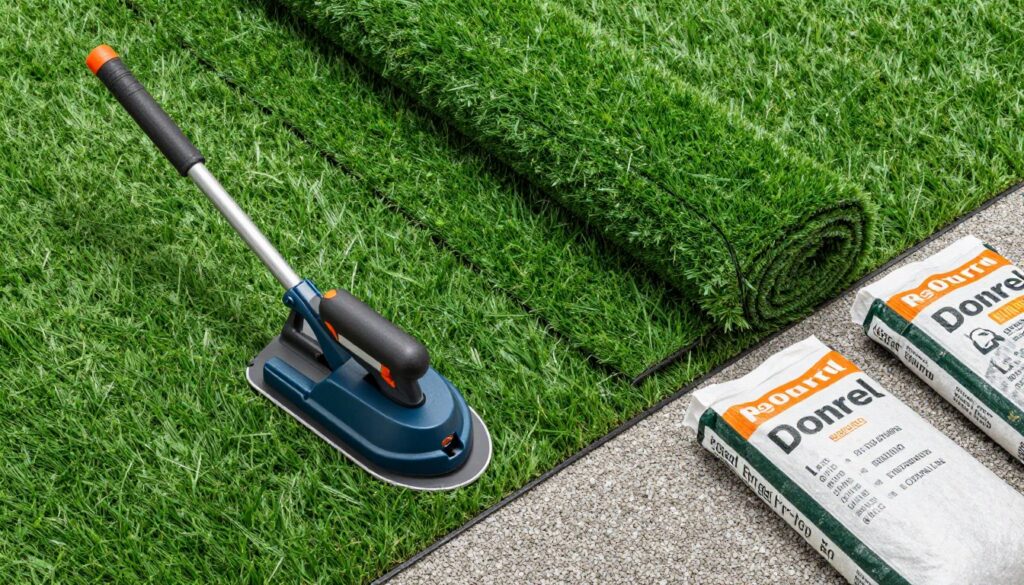
For a successful turf project, excavate to a depth based on existing grade, caliche, adjacent surfaces, and the selected turf system. Remove unsuitable soil, then install well-graded aggregate in compacted lifts. Decomposed granite and caliche may need evaluation before use.
Set a 1–2% slope away from foundations, never toward a neighbor’s property. Turf drainage cannot correct an impermeable or poorly graded subgrade. Secure edges to prevent movement, ripples, and seam stress.
Sub-base composition and compaction best practices
- Use geotextile only when soil conditions require separation or fines control.
- Compact each lift in multiple directions with suitable equipment.
- Add a smooth capping layer to protect artificial turf backing and installation quality.
Setting proper slope and perimeter containment
Verify grade before laying synthetic turf. Keep irrigation lines accessible and use restraints suited to the landscape surface.
Drainage performance for Las Vegas conditions
Choose synthetic turf products with perforated backing and documented drainage. Confirm any high-flow rating, such as 30 inches per hour per square yard, through manufacturer testing. Flash storms, pets, and sports field use require careful drainage design for durability.
| ElementRecommended SpecWhy it matters | ||
| Base | Well-graded aggregate; compacted in project-specific lifts | Supports the surface |
| Slope | 1–2% away from structures | Directs runoff safely |
| Drainage | Verified high-flow artificial grass system | Reduces pooling and odors |
| Edges | Compatible perimeter restraints | Keeps turf flat and secure |
Finish Laying Fake Grass With Proper Seams and Infill
Dry-fit turf panels, align the grain, trim mirrored edges, and inspect gaps before seaming. Apply compatible tape and adhesive, follow cure times, secure edges, spread infill, brush fibers upright, and inspect the finished grass.
Against-the-grain rolls create visible direction changes. In Las Vegas, choose heat-conscious products, provide shade where possible, and rinse the surface when appropriate because dark turf and infill become hot in direct sun.
- Use balanced infill for consistent appearance and drainage.
- Choose pet-safe, enzyme-compatible cleaning and odor-control infill for pets.
- Calibrate putting green infill for golf speed and true roll.
For rooftops, obtain written structural approval before adding turf, aggregate, or infill.
| DetailRecommended OptionWhy it matters | ||
| Seam method | Aligned grain, matched tape, full cure | Reduces visible joins |
| Infill type | Lawn, putting green, or pet-specific | Supports performance and safety |
| Finish | Brush, secure edges, inspect | Improves the look and maintenance |
Match each product to its applications. Landscape turf, putting greens, sports areas, and pet systems need different options, drainage, and performance standards; never assume one product suits every space.
Avoid Synthetic Turf Selection Mistakes
Compare products, warranties, and maintenance requirements with real grass expectations. Consider the variety of turf solutions available for sports, putting greens, pets, and other applications.
Pet systems and drainage-first design
Use permeable backing, drainage channels, odor-control infill, and routine rinsing for pets.
Confirm material safety claims before installation.
Putting greens, playgrounds, and sports
Specify pile height, infill, impact protection, and load requirements for putting greens, playgrounds, and sports.
- Verify certifications and written structural approval for rooftops.
- Choose turf for the intended play and traffic.
Safety and Compliance for Las Vegas Homes, Schools, and Facilities
Request safety data, product certificates, and technical sheets before installing synthetic turf. HOA CAD approval, municipal compliance, product certification, and a manufacturer warranty are separate requirements.
SNWA water-conservation guidance supports water-efficient landscaping but does not automatically approve every turf product or installation. Confirm lead-free and non-toxic claims in writing.
Material testing and building-code checks
Verify applicable flame, VOC, accessibility, and playground standards for each surface and use.
- Use certified playground systems and match tested fall heights.
- Inspect edges, seams, and trip hazards.
- Keep records for HOAs, schools, and commercial facilities.
Pet and accessibility protocols
Use pet-safe cleaners, rinse regularly, and direct runoff away from foundations. Maintain a stable base for accessible routes.
| RequirementActionWhy it matters | ||
| Certification | Collect product records | Supports safety and approval |
| Play safety | Match tested fall heights | Reduces injury risk |
| Maintenance | Brush, rinse, inspect seams | Preserves performance |
Create a maintenance plan for debris, infill, weeds, pet rinsing, and seam checks.
Durability Technologies for Las Vegas Turf
Intense UV exposure makes stabilization and documented fade resistance important. Ask for test data tied to the application rather than relying on general industry claims.
UV inhibitors, tuft bind, and backing strength
Compare UV protection, tuft bind, face weight, pile height, and backing across the product line. Request abrasion, tensile, and drainage results for the field.
Strong materials can improve durability over years, but never promise decades without a written, application-specific warranty.
- Inspect rolls for straight edges and even tufting.
- Choose technology suited to traffic and climate.
- Confirm expected performance and maintenance.
| TechnologyWhat to verifyBenefit | ||
| UV protection | Fade-test documentation | Resists color loss |
| Tuft bind | Pullout data | Reduces shedding |
| Backing | Seam and stability data | Supports quality |
Routine grooming and maintenance help preserve the turf surface.
Las Vegas Turf Installation, Delivery, and Local Service
Local logistics affect your project’s installation time. TaylorMade Landscapes® coordinates delivery, staging, narrow-gate access, hot-weather scheduling, and material disposal for Las Vegas homes and businesses.
Plan storage and access before ordering turf, infill, adhesives, and other products. This service reduces delays in tight space and helps protect materials from extreme heat.
Ask TaylorMade Landscapes® about local turf solutions, installer expertise, and a written scope for your property.
Planning delivery and site access
Confirm delivery routes, staging space, disposal, and weather timing before work begins. Keep repair materials available for future maintenance.
Our local installation process
Follow these steps: approve the design and HOA CAD; locate utilities and remove existing grass; excavate caliche and unsuitable soil; install and compact the aggregate base; set slope and edge restraint; lay, align, cut, and seam turf; then add infill, brush, inspect, and document the finished surface.
Warranties and workmanship documentation
Request product warranties, maintenance instructions, and workmanship documentation at handover. TaylorMade Landscapes® holds Nevada C-10 #0068037 and C-18 #0078652 licenses and is an SNWA Water Smart Contractor, subject to current verification.
Contact TaylorMade Landscapes® for a consultation covering residential turf, sports field, or putting green installation designed for dependable performance over the years.
| PhaseKey actionWhy it matters | ||
| Design | Approve HOA CAD and plan access | Prevents delays |
| Base | Excavate, compact, and set slope | Supports stability |
| Finish | Seam, infill, groom, and document | Confirms quality |
Final Checklist for Laying Fake Grass in Las Vegas
Before sign-off, confirm HOA CAD approval, utility locating, caliche excavation, a compacted base, safe slope, edge restraint, seams, infill, grooming, drainage, and maintenance. Artificial turf reduces routine irrigation, but cleaning and brushing preserve its look, safety, performance, and durability.
Choose quality products and solutions for your space and applications. TaylorMade Landscapes® provides local service backed by industry expertise for home, pet, landscape, sports, and putting-green projects. Contact the team to discuss options and installation.


